

The most common reasons Queensland learners fail their driving tests
By EzLicence · Last updated 9 Jan 2026
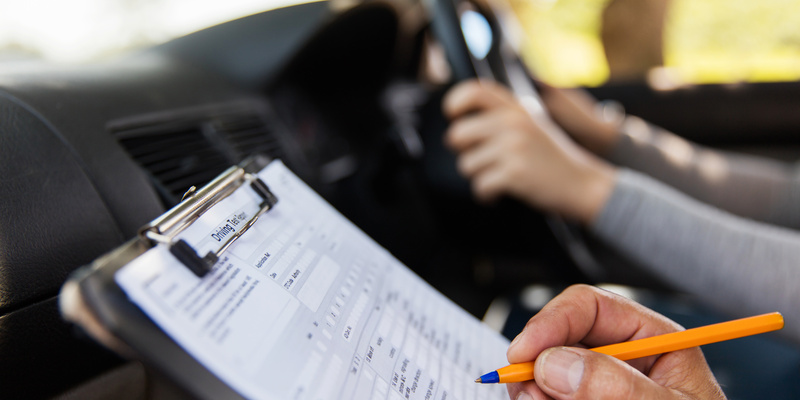
Learning to drive is an exciting milestone, but it can also be a stressful one. For many learners, passing the practical driving test on the first attempt remains a significant challenge, with nerves, unfamiliar scenarios, and unexpected obstacles all playing a role.
To better understand why some Queensland learners are struggling behind the wheel, EzLicence analysed Freedom of Information data. By examining the most common reasons learners fail their practical test, we uncover the key challenges new drivers face and highlight areas where extra preparation could make all the difference.
Queensland learner driver pass and fail rates 2021–2025
|
Exam Result |
2019 |
2020 |
2021 |
2022 |
2023 |
2024/ 25 |
Average 2021–2025 |
|---|---|---|---|---|---|---|---|
|
FAIL |
36.1% | 34.1% | 36.6% | 36.1% | 39.0% | 35.9% | 34.3% |
|
PASS |
63.9% | 65.9% | 63.4% | 63.9% | 61.0% | 64.1% | 58.6% |
Learning to drive is exciting, but the numbers show it’s not always easy for Queensland learners. Between 2021 and 2025, around one in three learners failed their practical driving test (34.3%), while just under 60% passed (58.6%). The results have fluctuated over the years. In 2020, the pass rate reached its highest point at 65.9%, while in 2023, the highest fail rate at 39%.
The good news is that the most recent 2024–2025 data shows pass rates are climbing again, back up to 64.1%, roughly in line with pre-pandemic levels. This suggests that while some years bring setbacks, possibly due to disruptions or changes in testing conditions, learners generally bounce back when circumstances stabilise.
It’s also worth mentioning that about 7% of tests between 2021-2025 didn’t fail because of driving mistakes, but because of other hurdles, like missing the test, using the wrong vehicle, or even bad weather.
Taken together, the data show that passing a driving test can be unpredictable. Multiple attempts are common, and factors such as nerves, unfamiliar scenarios, and the practical demands of the test can influence outcomes. These numbers highlight why thorough preparation, both in practice and for the test itself, can make a real difference for learners.
Queensland learner driving test pass rates by attempt
|
Test Attempt |
FAIL |
PASS |
|---|---|---|
| 1 | 32.5% | 60.9% |
| 2 | 36.2% | 57.3% |
| 3 | 37.4% | 54.6% |
| 4 | 38.8% | 51.2% |
| 5 or more | 44.1% | 43.3% |
Looking at learner performance across multiple attempts, most drivers pass within the first few tries. Of those taking the first attempt, around 61% pass. For learners who need a second attempt, 57% succeed, and of those taking a third attempt, 55% pass.
But the story changes the more attempts someone needs. By the fifth attempt, almost half (44%) of learners fail, slightly higher than the 43% who pass. At this point, passing the test actually becomes less likely than failing, highlighting how repeated attempts can be increasingly challenging—though it might also just mean some learners are having a really bad day behind the wheel.
Another notable trend is the increase in tests recorded as ‘other’, where learners were unable to complete the test due to factors like vehicle issues, paperwork, or even bad weather. This rate rises from 6.6% on the first attempt to 12.7% by the fifth attempt, suggesting that these unpredictable hurdles tend to become more common the more times a learner attempts the test.
Most common mistakes Queensland learner drivers make on practical tests
Avg % of errors across all attempts
| Rank | Error Type | 1 | 2 | 3 | 4 | 5+ | Average % of all errors across all attempts |
|---|---|---|---|---|---|---|---|
| 1 | Judgement Count | 40.5% | 41.3% | 40.2% | 41.5% | 40.5% | 40.7% |
| 2 | Observation Scanning Count | 37.3% | 36.2% | 35.5% | 33.9% | 32.4% | 36.5% |
| 3 | Signalling Count | 27.8% | 28.7% | 28.7% | 30.0% | 31.5% | 28.4% |
| 4 | Should Checks Count | 25.9% | 26.3% | 26.9% | 26.0% | 28.1% | 26.2% |
| 5 | Signs, Signals & Markings Count | 22.9% | 23.4% | 23.6% | 24.6% | 23.9% | 23.2% |
| 6 | Progress Count | 19.9% | 21.2% | 23.0% | 23.3% | 25.4% | 20.9% |
| 7 | Road Position Count | 17.5% | 18.2% | 19.8% | 20.3% | 23.8% | 18.2% |
| 8 | Speed Count | 17.4% | 18.1% | 18.0% | 18.5% | 18.7% | 17.7% |
| 9 | Safety Margins Count | 13.9% | 14.4% | 14.8% | 14.8% | 14.9% | 14.2% |
| 10 | Manoeuvre Positions Count | 10.0% | 10.4% | 11.0% | 10.9% | 12.8% | 10.4% |
To understand why some learners struggle more than others, it’s helpful to look at the most common mistakes made during practical tests. These reveal where learners are losing points and what areas require the most focus.
Judgement count, meaning the ability to accurately assess traffic situations and make safe driving decisions, was the most common error among Queensland learners, contributing to 40.7% of all errors across every attempt level. This clearly suggests that poor judgement is a key reason for failure.
Observation and scanning errors came in a close second, with 36.5% of all errors in this category. Clearly, many Queensland learners struggle to consistently check their mirrors and blind spots, and to properly scan the road ahead, including intersections and potential hazards.
Failing to signal, signalling incorrectly, or leaving indicators on unnecessarily rounded out the top three errors (28.4%). Interestingly, signalling count errors rise from 27.8% on the first attempt to 31.5% on the fifth attempt, highlighting the challenge learners face in consistently and correctly using their indicators.
Error severity in Queensland learner driving test failure
|
Test Attempt |
Serious Repeated Count |
Non-Critical Count |
Critical Count |
|---|---|---|---|
| 1 | 3.3% | 224.1% | 96.3% |
| 2 | 2.8% | 224.9% | 96.8% |
| 3 | 2.5% | 226.3% | 96.4% |
| 4 | 2.3% | 226.9% | 96.6% |
| 5 or more | 2.3% | 234.7% | 97.6% |
To get a clearer picture of what’s happening during these failed tests, it’s useful to look at the severity of the errors learners make and how these vary across multiple attempts.
Across all categories, Queensland learners were most likely to make non-critical errors, peaking at 234.7%. This means that for every failed test booking, learners make around 2.2 to 2.3 minor errors. It also shows that most failures aren’t down to just one mistake; instead, they usually reflect a wider struggle with overall driving skills and keeping a proper lookout on the road.
The critical count remains fairly consistent across all attempts, with 96.3% for attempt one and 97.6% for attempt five. Alarmingly, this suggests that nearly every failed test included at least one immediate fail item, such as speeding or not giving way. While learners may also make minor errors, their test failures are often caused by one critical mistake.
The low incidence of serious repeated features (peaking at 3.3%) confirms that learners in Queensland rarely fail based on repeating the same mistake; they fail because they commit a critical error.
Ross Rivalland from EzLicence shared tips to help learners pass their test on the first attempt:
- Anticipate other road users’ behaviour: Don’t just react—learn to predict what other drivers, cyclists, and pedestrians might do. This helps you avoid critical errors and shows examiners you have good judgement.
- Use a systematic mirror routine: Many learners fail because they don’t look consistently. Try a fixed pattern: check mirrors before changing speed, lanes, or direction, and always do quick glances at your blind spots.
- Practice smooth, progressive control: Jerky steering, braking, or clutch work draws attention. Slow, deliberate movements show confidence and control—even under pressure.
- Simulate test conditions in practice: Practise under realistic test conditions, like timed routes or with a ‘mock examiner’. Learning the test routes can help, but don’t rely on memorising them—unexpected situations can still appear. Driving instructors can recreate exam scenarios and provide objective feedback in lessons, helping you stay calm and confident on the day.
- Know common test ‘traps’: Simple mistakes like stopping too far from a line, rolling slightly on a hill start, or misjudging lane positioning are easy to miss. Being aware of these subtle pitfalls can prevent critical errors and improve your chances of passing.
About the data
To uncover the hidden hurdles between a learner permit and a provisional licence, we conducted a comprehensive analysis of practical driving test outcomes across Australia. Our study used data from distinct sources to provide a holistic view of learner performance:
- Official Test Data (FOI): Quantitative analysis of pass rates and specific fault recording.
- Public test data
Official Test Outcomes were derived from Freedom of Information (FOI) requests submitted to the transport governing body in every Australian state and territory. This data allowed us to dissect the "anatomy of a fail," categorising the specific driving errors—both critical (immediate fail) and non-critical (accumulated faults)—that prevent learners from progressing.

About the author